
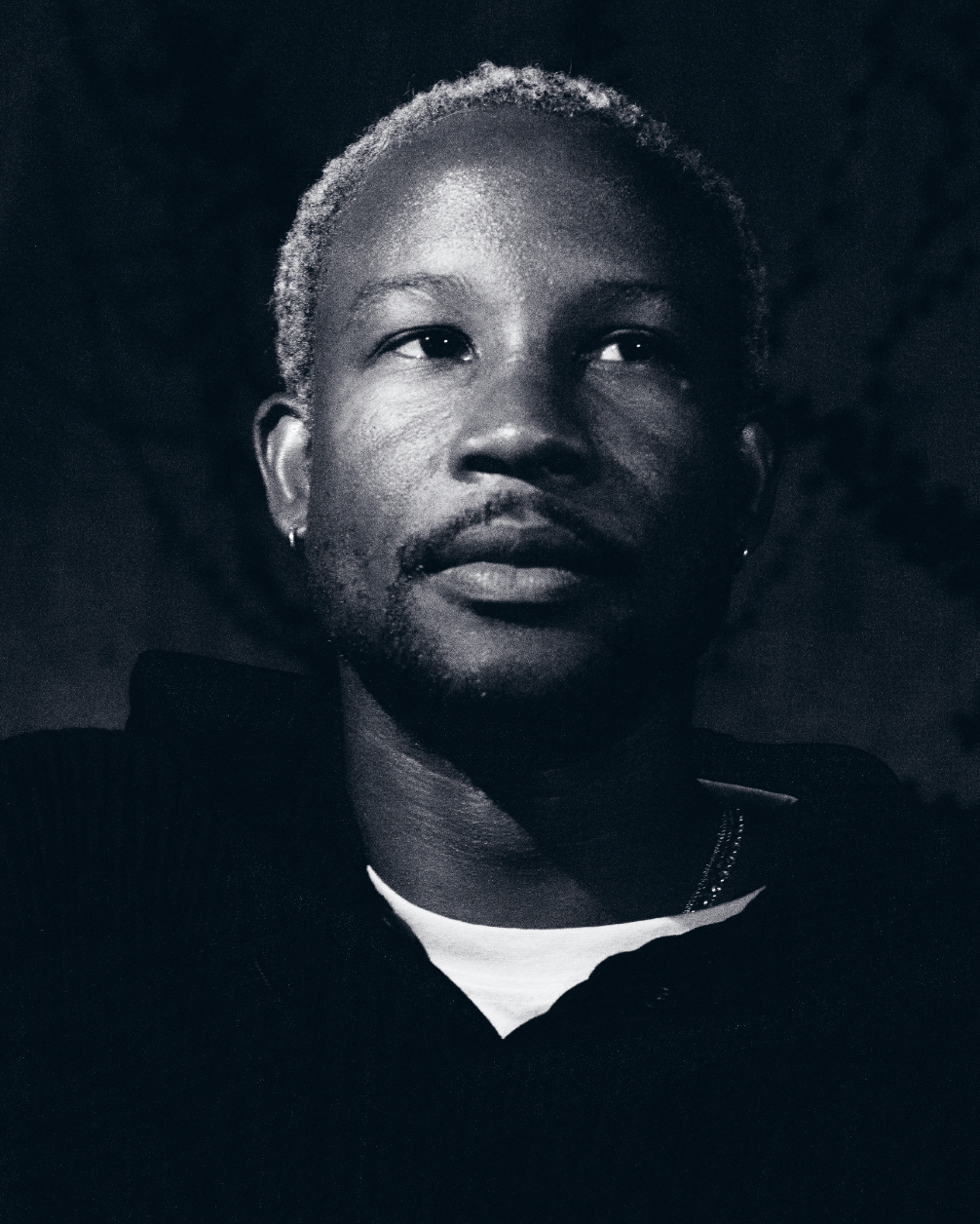
Akinola Davies Jr. The Shape of a Father
As My Father’s Shadow opens in French cinemas, director Akinola Davies Jr. reflects on Lagos, absence, and the fragile ties that shape us.
Nigerian-British filmmaker Akinola Davies Jr. belongs to a generation of directors redefining how stories about Africa are told on screen. Working between London and Lagos, he has spent the past decade crafting a cinematic language that moves between intimacy and scale, memory and urban energy. His latest film, My Father’s Shadow, a semi-autobiographical story unfolding over a single day in Lagos during Nigeria’s 1993 electoral crisis, follows a father guiding his two young sons through the city as political tensions quietly rise around them. The film is both a personal meditation on memory and a portrait of Lagos rarely seen on screen. In this conversation with CITY, Akinola Davies Jr. reflects on cinema as refuge, the quiet side of Lagos, masculinity, memory, and the poetry of images.
When did cinema become the language through which you felt you could express yourself?
I think films were always a means of escape for me, even before I realized it. When I was younger, I watched many kinds of films. Later, when I was in my twenties at university, I would place a big screen at the edge of my bed and spend hours watching cinema. It was a place I could escape to. I think I had an ambition to make films, but I was too scared to say out loud that I was going to become a filmmaker. I just loved getting lost in stories and in the work of classic filmmakers.
Cinema was always where I went for refuge. Whenever something in life felt good or difficult, it was the place I ran to. And even earlier than that, when I was around nine years old, a friend’s father was a film editor. I remember loving the atmosphere of their home, this very bohemian family life. Around the age of twelve or thirteen, I became very interested in the medium itself.
You grew up between places, between Nigeria and the UK. How did that shape your way of seeing the world?
It made me very curious. When you grow up between places, you realize very quickly that the world is not fixed. Growing up in Nigeria, I spent a lot of time in my imagination. I was always dreaming, imagining different worlds, different characters. Then being in England, especially in the countryside, was completely different. It was very quiet. But that quiet also gave me space to imagine.
I think living between those two places really encouraged my curiosity. Some simple things in one place are magical in another, and what seems magical somewhere else might appear ordinary somewhere else. When you move between these environments, it shapes your sense of identity. It also exposes you to different cultures, different manners of being in the world. Ultimately, it made me hungry to understand more about the world and how it works.
Your film My Father’s Shadow is deeply personal. Where did the story begin?
It started with a memory. My father passed away when we were children. I was twenty months old and my brother was about three years old. We both share a memory of playing on a bed with him. But the truth is that we don’t know if that memory is real, or if it’s something we created, or something that was told to us. The important thing is that we had this memory and we believed that we experienced it.
My brother later wrote a short story about wanting to spend a day with our father. When he shared it with me, I had a very emotional reaction. After that, we wrote a short film together. And a few years later we wrote My Father’s Shadow.
Through the father figure in the film, you also explore masculinity. What did you want to say about it?
In many African contexts, fathers and caregivers often don’t have the language to describe their feelings or their relationships. What the film allowed us to do was explore that relationship and offer some context. The absent father has become a stereotype. But we wanted to show why that absence sometimes exists. In many cases it comes from the need to provide for the family. At the same time, we also wanted to question certain forms of masculinity and hold them accountable. Understanding something does not mean accepting it without reflection. Masculinity is very dynamic. There are different forms of it. There is also a softer masculinity, which my brother and I experienced because we were raised by our mother. We were encouraged to explore our emotions. We wanted the film to open a more balanced conversation about masculinity.
Lagos itself feels like a living presence in your film. How did you approach filming a city that never slows down?
My brother and I have been working in Lagos for almost eleven years. We’ve shot short films, music videos, documentaries. We’ve worked with people from the grassroots level. Many people come to Nigeria and extract from it. They take and they take. But we always wanted to put something back into Lagos. Because we invested time in building relationships with people, we gained trust and access. When it came time to shoot the film, people understood what we were trying to do. We didn’t arrive with security guards or barriers. We moved around freely, with the community. People became part of the film. They protected us, helped us, gave ideas. They were invested in the process. That relationship allowed the city to open itself to us.
Visually, the film carries a very particular atmosphere.
My cinematographer, Jermaine Edwards, and I developed a visual language together. This was his first feature film. We talked a lot about the idea of decay. Imagine a piece of fruit: from one side it looks perfect, but when you turn it around you see the mold. That idea appears in many places in the film. It suggests that something is slowly breaking down. Perhaps the character is decaying, perhaps the city, perhaps the relationship itself. These were intentional visual ideas that guided the cinematography.
Lagos is often described as chaotic. Do you try to control that chaos, or surrender to it?
You have to surrender to it. If you try to fight the chaos of Lagos, you won’t win. And you probably won’t enjoy the experience either. It’s a city you have to move with. When you follow its frequency, it rewards you. You discover things every day. You see how generous people are, how curious they are about the rest of the world, how much they want to share their stories. People often describe Nigeria as chaotic, dangerous, exciting. And sometimes it is. But sometimes it is slow. Sometimes it is beautiful. Sometimes it is difficult. All of those contradictions are what make a place special.
When you think of Lagos, what sensations define it for you?
For me, it’s actually the stillness. Most people experience Lagos through the noise of Victoria Island or Lekki. But I grew up on the mainland, in a quiet neighborhood. From our house I could hear the call to prayer from the mosque. I could hear birds. I could hear children playing. That’s the Lagos I still love. The quieter Lagos that people rarely talk about. Because the city is so charismatic and energetic, people often forget the moments of silence and calm that exist there too.
Silence also seems to play a role in your filmmaking.
Silence gives the viewer space. It allows them to project their own emotions and memories onto the screen. It invites people to think about their own families, their own experiences. To imagine what it would mean to spend a day with someone who is no longer alive. When people pass away, we sometimes turn them into perfect figures. But the truth is that they were human. They made mistakes. Remembering that humanity is important.
There is also a strong sense of poetry in your film. What does poetry mean to you?
Poetry is like romance. It’s a kind of seduction, but a vulnerable one. Poetry opens your chest to your heart and your soul. It speaks to longing, to desire, to yearning. It’s about slowness and attention to detail. A leaf on a tree can just be a leaf. But in poetry, the way that leaf moves becomes hypnotic. I think the world could benefit from paying attention to that kind of detail again. We move very fast, and sometimes we become cynical. But poetry reminds us that we’re human. Sometimes I look at the moon and I think it’s the most beautiful thing I’ve ever seen. Or I watch a bird flying and feel amazed. Even though life can be difficult, there is still so much beauty around us.
In the end, what matters most in an image: what is shown, or what is withheld?
What matters most is what is felt. When I started making films sixteen years ago, I didn’t necessarily think of myself as an artist. I was assisting other directors and photographers. I had a strategic mind, so directing came naturally. But cinema has taught me that the most important thing is to make people feel something. Whether that feeling is positive or uncomfortable doesn’t matter. The image is simply a conduit. If we listen more to our feelings and to our intuition, maybe we can understand ourselves better and evolve.
What do you hope audiences unfamiliar with Nigeria will feel after watching the film?
I hope they become curious. Nigeria has a strong reputation in the world. People might think of football, or corruption, or danger. But if you look beyond those clichés, you see a country with the largest population in Africa and incredible diversity. There are hundreds of languages, hundreds of cultures. The people are generous, funny, curious about the rest of the world. They want to share their stories. I hope the film encourages people to see Nigerians as human beings rather than stereotypes. Our histories are connected and intertwined.
What stories do you want to tell next?
I’m not sure the next story will take place in Lagos. But I definitely want to continue telling stories about Nigeria. When I was younger, I didn’t have as much access to the country as I would have liked. Through cinema, I’m discovering it again. I want to meet people from different regions, understand their histories, and help them tell their stories. What matters is sharing our resources, our platforms, and our stories. Every story deserves to be heard.
My Father’s Shadow (Un Jour avec mon père),
directed by Akinola Davies Jr.,
starring Sope Dirisu, Godwin Chukwudi
and Chibuike Marvellous Egbo, in French cinemas March 25, 2026.