
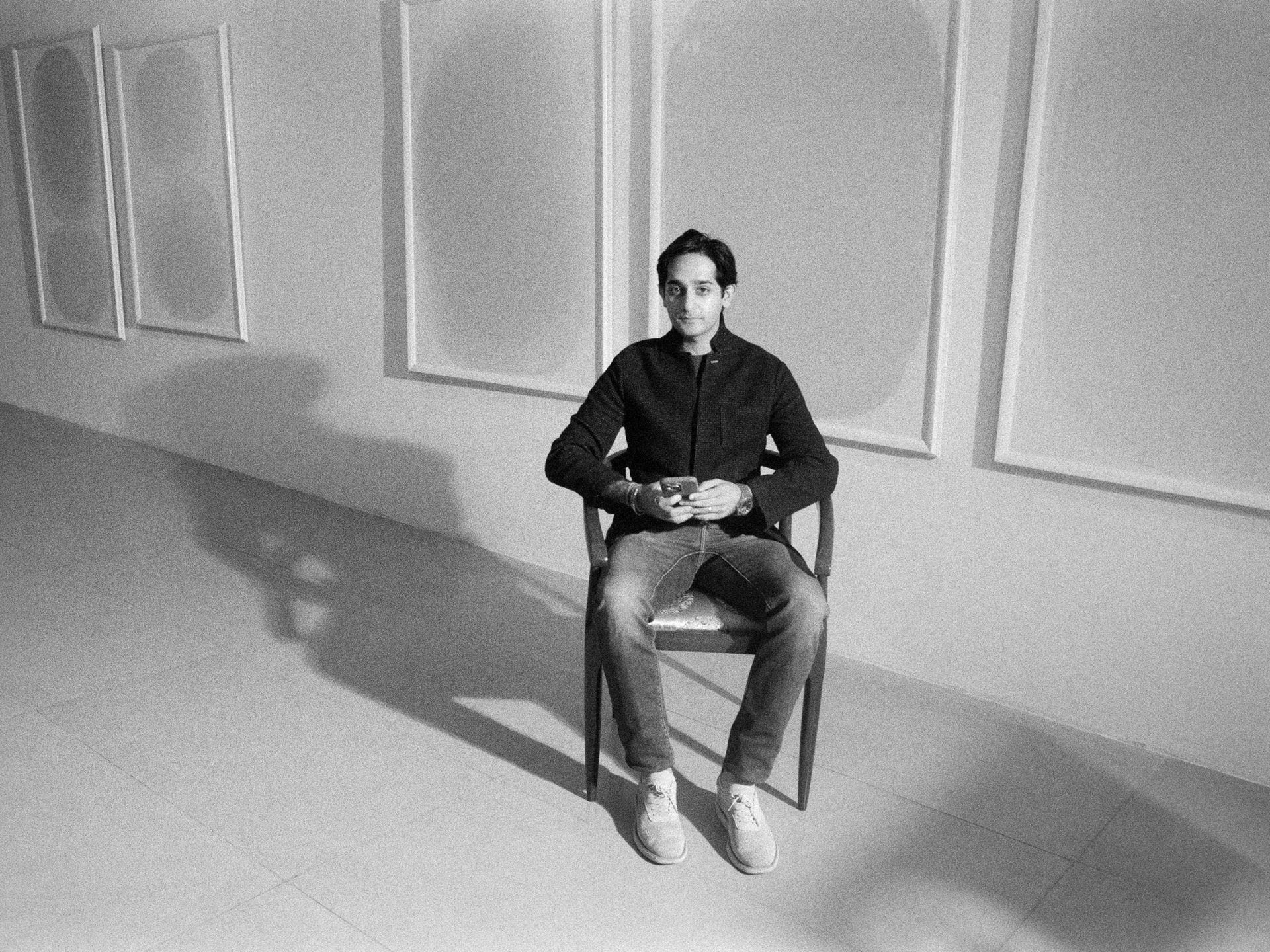
Arjun Buntani: A gallery should feel like buying bread.
A lawyer by training and a collector from a young age, Arjun Buntani came to art through curiosity, first in London’s museums, then through friendships with artists, fairs, biennales. Today, from their space in Defence Colony, the two Arjuns are helping shape a new chapter for Delhi’s contemporary scene: open, international, and emotionally driven. For CITY, Arjun Buntani reflects on beginnings, partnerships, responsibility, and why a gallery should never feel intimidating.
You were trained as a lawyer. How did contemporary art enter your life?
I was living in London at the time. Between my law school classes, I enrolled in a course at the Victoria and Albert Museum. I started going to the V&A, to the Tates, to the larger institutions. I was exposed to art I had never seen before. The first large-scale contemporary artist who truly struck me was Yayoi Kusama. I had never heard of her. It felt completely out of this world. From there I discovered Anselm Kiefer, and I spent hours at the National Portrait Gallery. London is such a museum city. Curiosity becomes a habit. You look at a painting, and you want to read about it, understand the story behind it.
I was living in Marylebone, close to Mayfair. Beyond the major institutions, I began wandering into smaller galleries showing emerging artists from all over the world. That mix (the Gagosians and the tiny independent spaces) shaped me. Very early on, I began collecting. I made it a point to collect artists from my own generation. I believe young people should collect their contemporaries. When you grow older, you see not only your own journey, but the journey of the artists you believed in.
At what point did collecting turn into founding a gallery?
Collecting created friendships. I started travelling for art, fairs, biennales, always from the commercial side, acquiring, observing. About three years ago, I met my partner, Arjun Sani, in Delhi. He had been collecting since he was 17 or 18. His relationship with art was long-standing, and he had already curated for galleries such as Nature Morte and Vadehra. Opening his own gallery had been a lifelong dream.
For me, there were two incentives: to help realise his dream, and to finally stand on the other side of the art world. That’s how Pristine was born. The first two years, we didn’t have a permanent space. Now we do, in the heart of Delhi. We open exhibitions every six to eight weeks. It’s a treadmill we love walking on.
Why Defence Colony?
We are in South Delhi, on a busy road yet inside a neighbourhood. Accessibility was essential. For me, going to a gallery should not feel like attending an occasion. In London, I would walk around with a coffee, in track pants and a hoodie, and spontaneously step into a gallery. I didn’t want Pristine to be intimidating. I wanted it to feel like going out to buy bread: casual, natural, part of daily life. A gallery must be accessible not only to collectors, but to students, couples on dates, people simply curious.
The name “Pristine” suggests clarity. What does it mean to you?
“Pristine” means clear, clean. It comes from the Latin pristina, clarity. We don’t define ourselves by geography or medium. We don’t say we will only show South Asian artists, or only European, or only emerging. Our program reflects who we are: curious, diverse, evolving. Art is subjective. If it touches you, it touches you. If it doesn’t, that’s fine too. What matters is clarity; knowing what we respond to emotionally. Perhaps we are slightly minimalist in spirit. But we refuse boxes.
How do you and Arjun Sawhney complement each other?
On most things, we agree easily, aesthetically, culturally, even in lifestyle. But we also balance each other through experience and perspective. He has been in the art world longer than I have. I respect that experience. At the same time, I represent a younger generation, aware of shifting trends and new audiences. If he doubts something, I may encourage him to look forward. If I hesitate, he brings historical grounding. There is a significant age gap between us, but our thoughts are aligned. It’s a blessing, personally and professionally.
You show both established and emerging artists. How do you navigate that balance?
We embrace both. We have shown artists such as Kumari Nahappan, a major Singaporean artist of Indian origin collected by museums worldwide. At the same time, we represent emerging talents like Varad Bang from Aurangabad, trained at the Florence Academy. Working with emerging artists is incredibly rewarding. You witness the trajectory from the beginning. Five or ten years later, you can look back and trace the story. Interestingly, in India today, mature collectors are acquiring emerging artists, while younger collectors are purchasing editions or smaller works by established names. The ecosystem is becoming more fluid.
How do you choose a new artist?
In truth, galleries show what resonates with them. At Pristine, we ask ourselves a simple question: when you stand in front of the work, do questions arise? Does it speak? Can you feel the artist’s struggles, joys, convictions? Emotion is the litmus test. It can be about childhood, political tension, romance, contemplation… but it must convey something authentic. We also value trust. Representation is a relationship.
Which artists continue to inspire you?
Anselm Kiefer remains a constant reference. I admire how he bridges abstraction and figuration. I have long followed Hiroshi Sugimoto: his liminal seascapes and theatre photographs are timeless.
In India, Arpita Singh deeply moves me. She is nearly 90, yet her work retains a childlike quality. Recurring motifs (benches, couples, flowers) create a universe that is unmistakably hers. And Saskia Pintalon, whom we represent, embodies playful social commentary. When you meet her, you realise the paintings are simply her personality translated into canvas.
In India, Arpita Singh deeply moves me. She is nearly 90, yet her work retains a childlike quality. Recurring motifs (benches, couples, flowers) create a universe that is unmistakably hers. And Saskia Pintalon, whom we represent, embodies playful social commentary. When you meet her, you realise the paintings are simply her personality translated into canvas.
Was there a defining exhibition for the gallery?
Our debut in March 2023 was a retrospective of Saskia Pintalon, including works previously shown at the Venice Biennale. But a recent milestone was Varad Bang’s solo exhibition inspired by In the Mood for Love. We transformed the gallery into a Hong Kong-style apartment, with velvet drapes, dim lighting, palms, music from the film. It became immersive, almost theatrical. It was commercially and creatively successful, and it pushed us beyond conventional display.
What recently moved you as a viewer?
At Naoshima, I saw Yayoi Kusama’s Narcissus Garden. The mirrored spheres reflecting infinite versions of yourself. It was powerful.
In Thailand’s Khao Art Forest, I encountered Louise Bourgeois’s Maman in a tropical landscape, Buddhist monks walking around it. The setting transformed the sculpture.
And at the Bukhara Biennale, Subodh Gupta’s ceramic kitchen installation, produced entirely locally, was striking in its contextual depth.
In Thailand’s Khao Art Forest, I encountered Louise Bourgeois’s Maman in a tropical landscape, Buddhist monks walking around it. The setting transformed the sculpture.
And at the Bukhara Biennale, Subodh Gupta’s ceramic kitchen installation, produced entirely locally, was striking in its contextual depth.
What does Delhi represent to you?
Delhi is madness, in the best way.
It is juxtaposition and dichotomy. Mughal tombs, colonial structures, contemporary towers. Traditional weddings and corporate cafés serving crêpe Suzette. It is a city layered by empires and ambition.
India’s youth are hungry. For business, creativity, expression. Delhi is in transformation. Architecturally, culturally, socially. Bombay has long been considered the cultural capital, but Delhi is shifting. Young audiences are curious about international art. Pristine is currently the only gallery in Delhi showing a consistent international programme. We believe the city is ready.
It is juxtaposition and dichotomy. Mughal tombs, colonial structures, contemporary towers. Traditional weddings and corporate cafés serving crêpe Suzette. It is a city layered by empires and ambition.
India’s youth are hungry. For business, creativity, expression. Delhi is in transformation. Architecturally, culturally, socially. Bombay has long been considered the cultural capital, but Delhi is shifting. Young audiences are curious about international art. Pristine is currently the only gallery in Delhi showing a consistent international programme. We believe the city is ready.
What is the responsibility of a contemporary gallery today?
To amplify voices. Artists want their stories heard, their causes acknowledged. Exposure is the first responsibility. But education is equally important. I want school students, art students, first-time visitors to enter the space. Not necessarily to buy, but to feel something. On difficult days in my life, walking into a gallery has been therapy. A gallery builds community. It nurtures collectors, encourages private institutions to open their collections, and broadens participation. Giving back is not theoretical: it’s about access.