
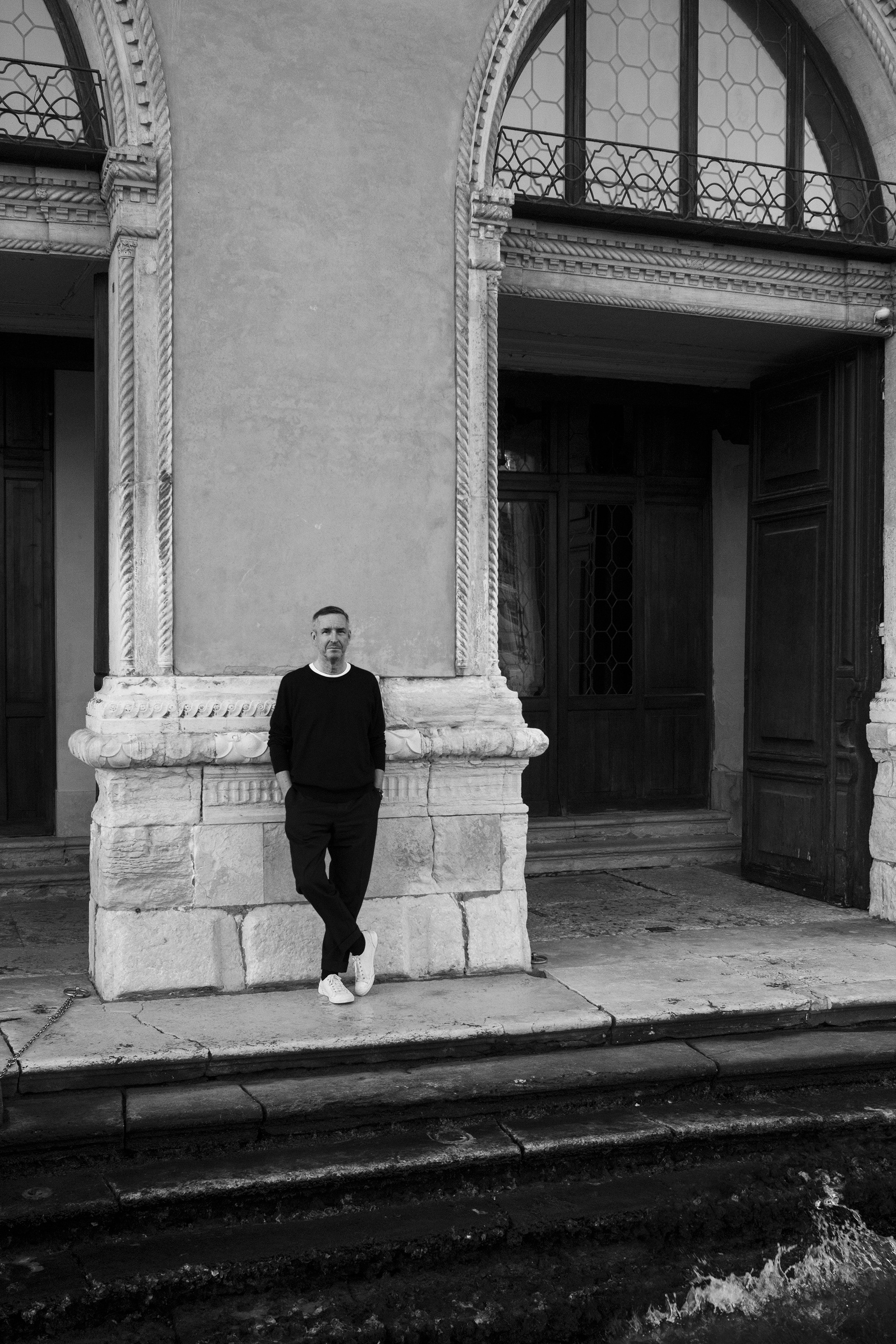
Photo by Camilla Glorioso
Inside Dries Van Noten’s Radical Palazzo
In Venice, this spring, beauty refuses to behave. In a palace still intact, before its restoration, suspended between past and disappearance, the Fondazione Dries Van Noten opens its doors. The setting: Palazzo Pisani Moretta, resting on the Grand Canal. The gesture: a first exhibition with a manifesto-like title, The Only True Protest Is Beauty. A line borrowed from 1960s protest singer Phil Ochs.
You enter through the portego, the palace’s vital axis, and immediately, something resists. A sculpture by Peter Buggenhout, almost shapeless, covered in dust, as if refusing to be looked at. Here, nothing is decorative, everything is dialogue. In one salon, beneath a triumphant ceiling (The Victory of Light over Darkness), contemporary photographs by Steven Shearer of sleeping bodies confront Codognato’s memento mori jewellery. Between them, silhouettes by Christian Lacroix and Comme des Garçons. There is sleep and there is death, there is couture and there is ritual. Further on, insects become goldsmiths, literally. In Hubert Duprat’s work, larvae build their cocoons using gold, rubies, and pearls. Nearby, the delicate glass works of Ritsue Mishima catch the Venetian light, extending this fragile dialogue between nature and artifice. Nature turns into a workshop. Beauty becomes an accident.
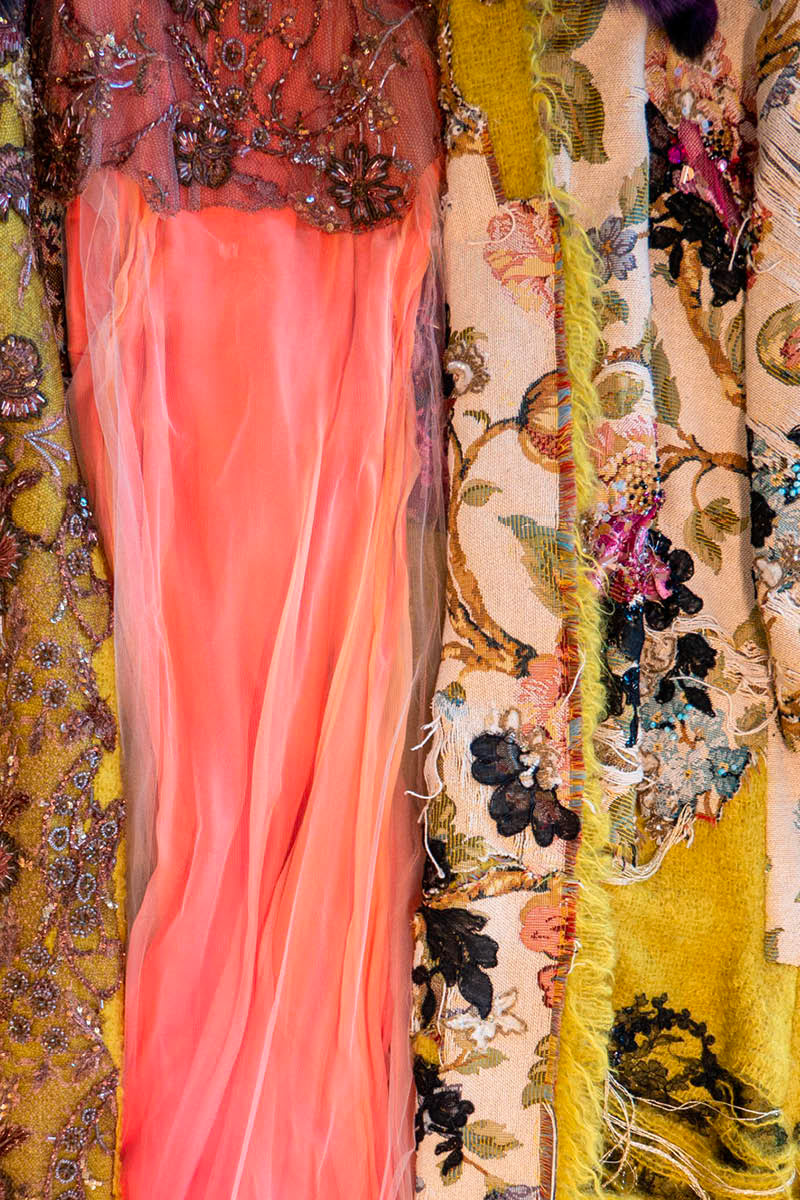
Christian Lacroix, Haute Couture FW 2003(Courtesy of Christian Lacroix, STL group, coat by courtesy of Madame Suzanne Saperstein Photo by Christian Lacroix.
Fashion, matter, memory
Fashion here is not a backdrop but a structure. Fifteen Lacroix silhouettes, some never shown before, echo the palace’s excess and ornamentation. Opposite, Rei Kawakubo imposes abstract volumes, almost autonomous, like living entities. Beauty becomes volume, constraint, a question. Then another voice emerges: Palestinian designer Ayham Hassan. His garments seem shaped by limitation, by reality itself. An aesthetic of resistance. Everywhere, materials speak. Ceramics by Kaori Kurihara, hybrid objects, glass, textiles. Crystallized vases, chairs by Lionel Jadot wavering between sculpture and function, assemblages made of discarded metal. Nothing is fixed.
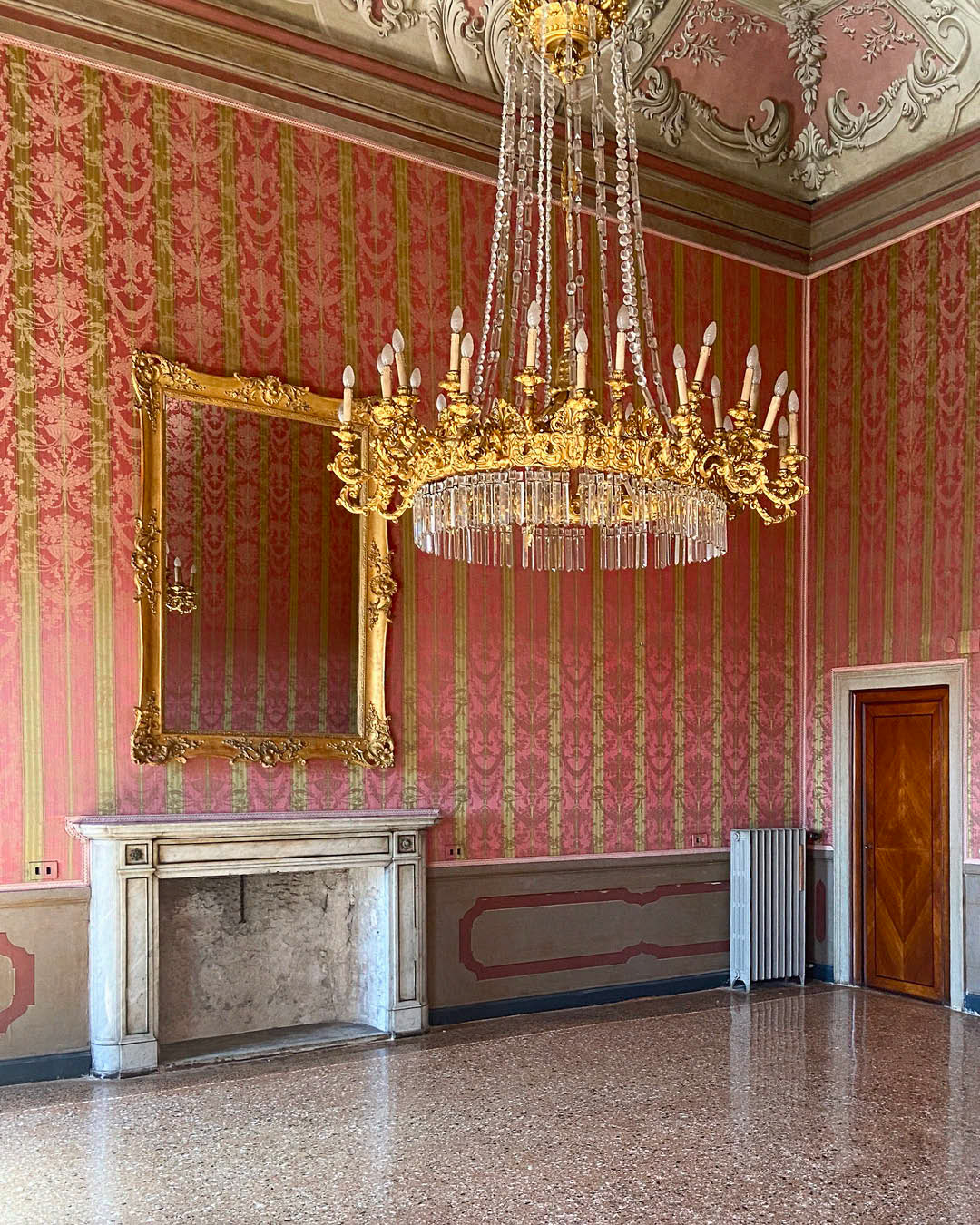
Photo courtesy Fondazione Dries Van Noten.
An invisible thread: rupture
“We are interested in beauty not as an answer, but as a question,” say Dries Van Noten and Patrick Vangheluwe. What runs through the exhibition is not harmony but its opposite: a tension stretched between beauty and disturbance. Each time the eye settles, something shifts: a dissonance, a detail, a quiet strangeness. As if beauty, here, could only exist in a state of instability: “When beauty allows for ambiguity, slowness, and contradiction… then it becomes a subtle form of protest.” There is something almost melancholic about the exhibition. The palace remains in its current state before transformation. In an age saturated with images, opinions, instant positions, Dries Van Noten proposes something else: to slow down, to look longer, to accept not understanding immediately. To make beauty not an escape, but a way of inhabiting the world. A way, perhaps, of resisting it.
The Only True Protest Is Beauty
April 25 - October 4, 2026
Fondazione Dries Van Noten, Palazzo Pisani Moretta
San Polo, 2766, 30125 Venice, Italy
https://fondazionedriesvannoten.org/en
April 25 - October 4, 2026
Fondazione Dries Van Noten, Palazzo Pisani Moretta
San Polo, 2766, 30125 Venice, Italy
https://fondazionedriesvannoten.org/en