
FRANCIS KURDJIAN: Fragrance as a narrative
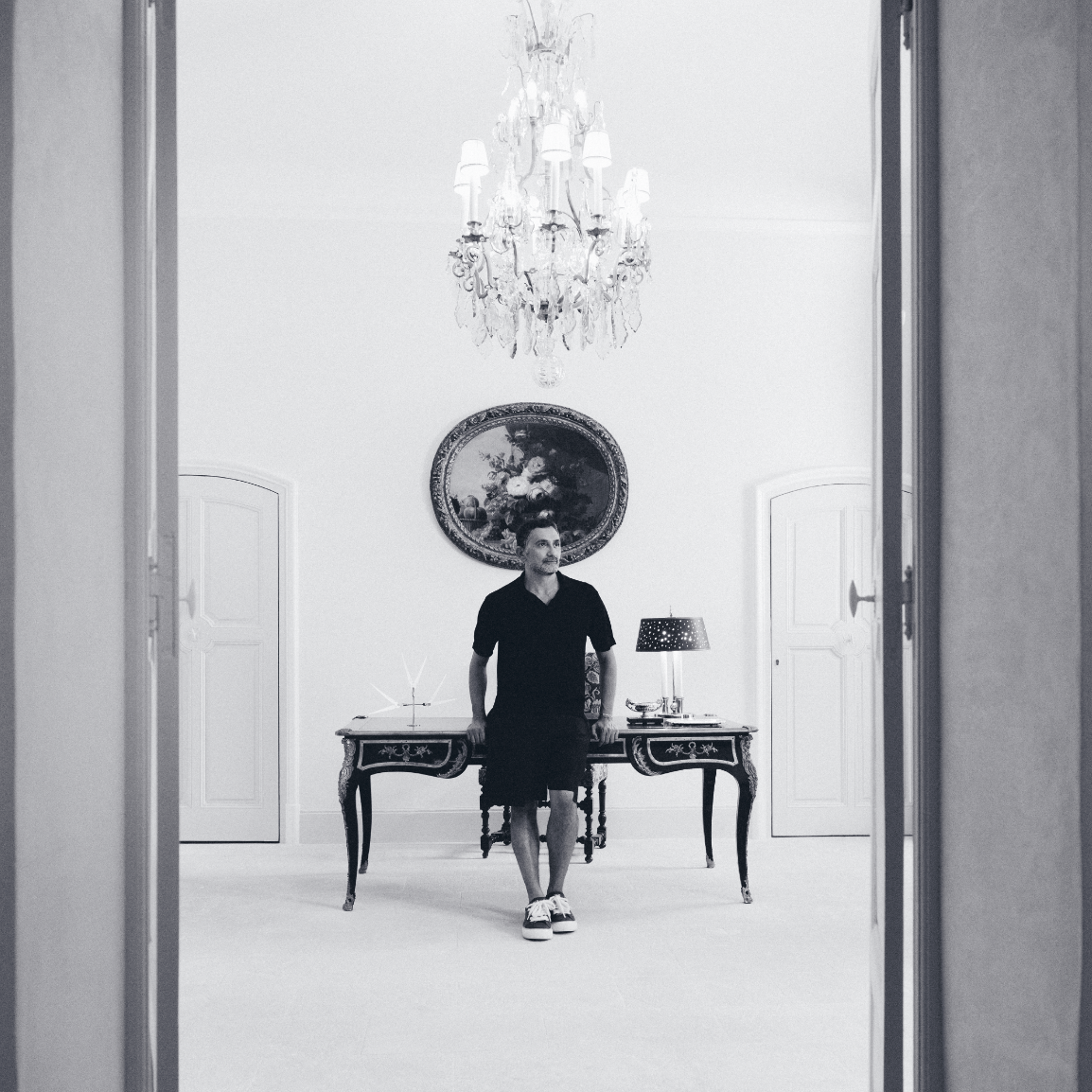
It was in Christian Dior’s home, in Provence, that we met Francis Kurkdjian. Photographed within the peaceful walls of the Château de La Colle Noire, where Dior once came to recharge, the man who has led fragrance creation at Dior since 2021 spoke to us about creation, invisible architecture, leather, and memory. Balancing artisanal precision with poetic intuition, the perfumer pursues a singular body of work, guided by a single compass: the story to be told.
For Francis Kurkdjian, a perfume is a narrative. “I express stories. Everything I can’t say with words or images, I put into perfume,” he confides. A statement that sets the tone: the perfumer does not begin with emotion, but with an internal narrative. “Emotion comes later. Story always comes first. If you don’t know what you want to say, you drift, waste time, and it goes up in smoke.” For him, creation is a quest: the pursuit of a fantasized fragrance. “Each trial is like a recipe. And each time, you think it might be the one. But if it’s not right, you start again. There’s a kind of hope in every formula.” And that search can last a long time… A very long time. “You can chase an idea for months.” During these creative phases, Francis Kurkdjian admits to entering a nearly obsessive, almost reclusive state. “I don’t see many people, I’m vulnerable. I love that phase, but it demands effort. Otherwise, it can become chaos at home…”
Asked about the link between fragrance and architecture, Francis Kurkdjian responds with nuance. Yes, there are structures, balances, lines of force. “But you can’t be too literal. A perfume belongs to an olfactory family, just as architecture belongs to a style. Leather, for example, is a theme in itself in the history of perfume.” Leather is precisely at the heart of his latest creation for Dior’s Collection Privée. Cuir Saddle, inspired by the House’s iconic bag designed by John Galliano for the Spring-Summer 2000 collection, explores a new kind of sensuality: “I wanted a morphological leather, one that clings to the skin like a continuation of the body. The most beautiful perfumes, for me, are those that die at the nape of someone’s neck. The ones you can no longer distinguish from the skin. They make you believe it’s the skin itself that smells.” Cuir Saddle is thus composed with a leather note that melts into the pores, as close as possible to the intimate.
This creation follows a remarkable path. Francis Kurkdjian has been Dior’s Director of Fragrance Creation since October 2021, succeeding François Demachy. He is also the founder of Maison Francis Kurkdjian, launched in 2009 with Marc Chaya, and a pioneer of niche perfumery. From the beginning, he introduced the concept of bespoke fragrance, a then-radical approach that affirmed a deeply personal vision of perfume: more intimate, more narrative, freer. In his Dior atelier in Paris, spacious and serene, he embraces a certain comfort. The setting matters. And some places, like La Colle Noire castle, add an even more personal dimension. It is there, in Montauroux, at the countryside home Christian Dior acquired in 1951, that we met him. Restored by the House in the 2010s, this place is much more than a Provençal retreat.
It is a manifesto. Dior himself wrote in his memoirs: “I dreamed of one day living in a true Provençal country house, surrounded by cypresses and olive trees.” Francis Kurkdjian enjoys spending time in this sun-drenched and tranquil setting, gently punctuated by the sound of cicadas, and still imbued with the designer’s protective presence. Just as exacting in language as in composition, he pushes back against terms he finds disrespectful: “The word ‘juice’ (the French slang often used to describe a fragrance, ed.) is simply unacceptable. You wouldn’t call a book a rag. A perfume is a creation.” He likewise resists being reduced to a mere ‘nose’: “I am a thinking being. I compose; I don’t just sniff.” Nor does he identify with the label “master perfumer”: “That doesn’t mean anything. It’s not like a MOF (Meilleur Ouvrier de France). There’s no official diploma. I’m a perfume composer. That suits me just fine.” Creating also means working with materials: “Lemon lasts 20 minutes. Vanilla, hours. You have to juggle those constraints. Like an architect with stone, a couturier with fabric, or a musician with an orchestra.”
Paris, of course, remains a cornerstone. “I always wanted to live there. As a child, I watched the city pass by through the window of my father’s DS. Rue de Rivoli, the Seine, the Île de la Cité…It was a dream.” But when asked to create a scent inspired by a city, he draws a clear line: “The smell of a city doesn’t mean anything. Paris is as much the 8th arrondissement as it is the 13th or 19th. You can’t reduce it to a single note.” And does he wear perfume himself? “Never. I don’t like it. I love creating them. I wear them when I’m working, to test. But otherwise, no.” As for his grooming routine? “Just hot water. My dermatologist told me 25 years ago to stop using soap. I listened.” Beneath this precision and conviction lies a touch of anxiety: the fear of failure, of disappointing. Yet that pressure never stops him from believing in the power of perfume. “Can a scent comfort? Move you? Yes, absolutely. It can be the scent of someone you love. Of someone who’s no longer here. That alone is a story.” And with Francis Kurkdjian, each perfume begins as just that: a story, shaped in the silence of a studio, somewhere between memory and architecture, in the shadows of the skin.
Photos by Audoin Desforges