
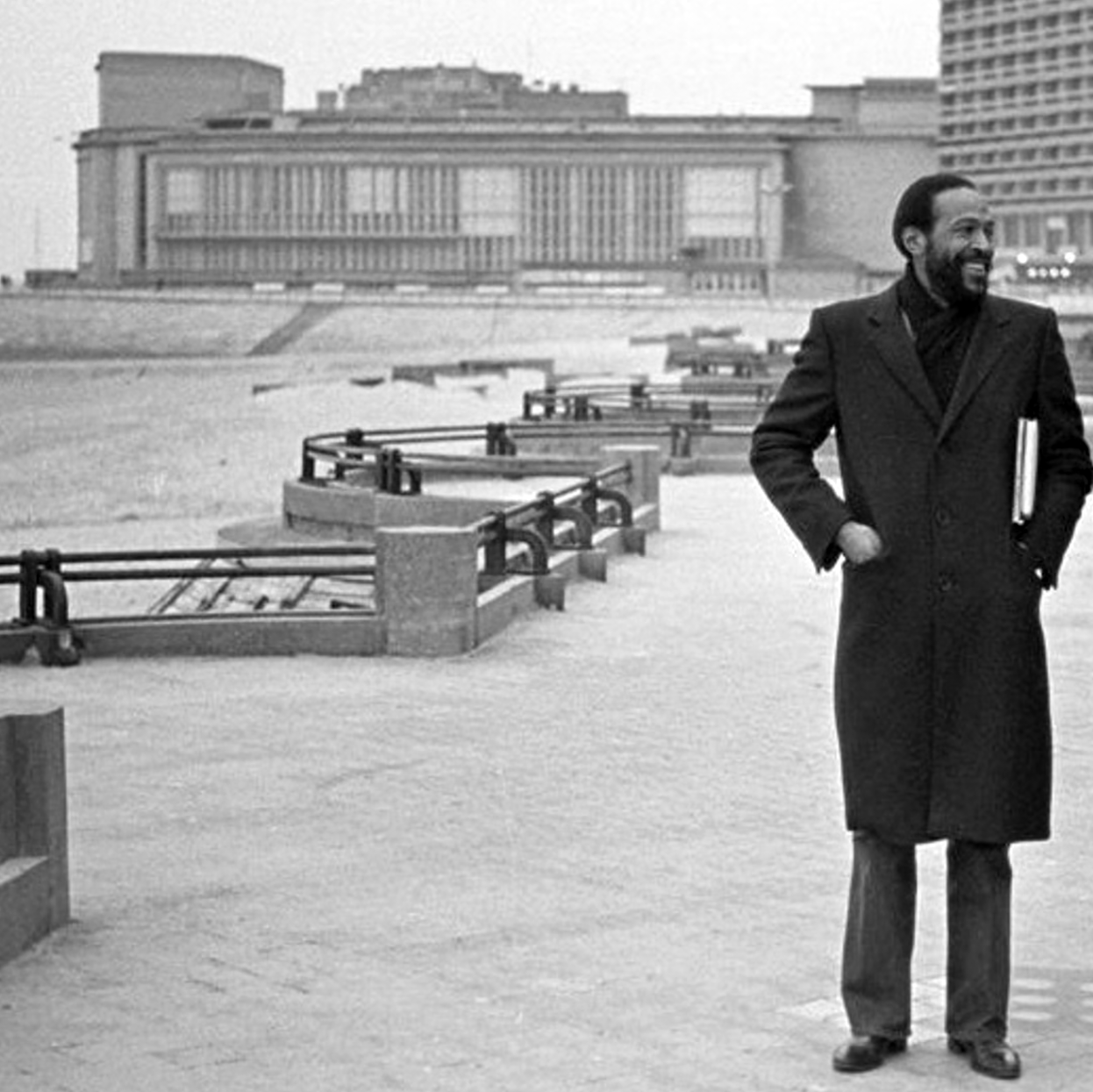
Photography by Jean-Jacques Soenen
The Belgian City That Revived Marvin Gaye
In 1981, at the lowest point of his life, Marvin Gaye quietly disappeared from the American music scene and resurfaced somewhere unexpected: Ostend. Belgian writer Serge Honorez explores this little-known episode when a quiet North Sea city, far from Motown and Los Angeles, became the backdrop for one of the most iconic songs in soul music: Sexual Healing.
In the early 1980s, at a moment when his life seemed to be collapsing under the weight of addiction, debt and exhaustion, Marvin Gaye quietly disappeared from the American music scene and resurfaced somewhere unexpected: the Belgian coast. Invited by local music promoter Freddy Cousaert, the soul legend settled for a time in Ostend, a faded seaside resort where, paradoxically, anonymity and distance offered him a rare form of breathing space. It was there, far from Detroit, Los Angeles and the pressures of Motown, that Marvin Gaye recorded Sexual Healing, the song that would mark his return and become one of the defining tracks of modern soul. In Marvin Gaye chez les Belges, Belgian writer Serge Honorez revisits this little-known episode with the patience of an investigator and the eye of a storyteller. Moving between memory, myth and historical reconstruction, he explores how a small coastal city, a handful of encounters and a moment of personal fragility unexpectedly became a turning point in the life of one of the greatest voices in popular music. We spoke with Serge Honorez about Marvin Gaye, Ostend, and the strange ways in which legends are sometimes written far from the places where we expect them.
Your book begins almost like a film scene: a quiet garden in Belgium, a young man (yourself) looking over a hedge… and Marvin Gaye appears. Looking back on that moment today, do you feel that, without realizing it, you were witnessing a moment of history?
With hindsight, yes, it does feel like a scene written afterwards. At the time, it was not experienced at all as a historical moment. It was simply a strange apparition: an unexpected neighbour behind a hedge, in a very quiet garden in the Belgian countryside. Only with time do you realise that certain images become symbolic. At that moment, no one imagined that this man on the run was recording one of the greatest songs in soul history.
There are many myths surrounding Marvin Gaye. Yet what you describe is a very concrete story: a lost artist, a northern European port, a local producer, an improvised studio. Was it important for you to bring this legend back to a more human scale?
Yes, it was important, but not to reduce the legend. Rather to place it back in its reality. We often imagine Marvin Gaye’s Belgian episode as a marginal exile, almost improvised. In reality, the context is more complex.
First of all, the studio was not improvised. It was simply located in the suburbs of Brussels, far from the major centres of the music industry. And Ostend may be an improbable port, but it is also historically a point of passage between continental Europe and England. In 1981, it was still an important hub for music, clubs and records. It was not the periphery of the musical world; it was another gateway into it.
And then there is Freddy Cousaert. His initial conviction was simple: to offer Marvin a healthy life, far from pressures and excess. A refuge. But I think that, with time, Cousaert himself understood something more ambiguous. Perhaps one cannot really repair the life of an artist like Marvin Gaye. What he could offer him, in the end, was above all the illusion of a healthy life, a temporary space where everything seemed possible again. And sometimes that illusion is enough for the music to return.
Ostend almost becomes a character in the book. The sea, the cold, the slightly faded hotels along the Belgian coast… How did this atmosphere contribute to Marvin Gaye’s rebirth?
What surprised him most in Ostend at first was perhaps the most ordinary thing: nobody recognised him. For an artist whose every gesture had been observed, commented on and mythologised, it was almost unreal. In the street, people did not see a soul legend. Some simply thought he was one of the players from the local basketball team. And in fact, nobody really cared.
When he gave a concert in the large hall of the Casino, only two thirds of the seats were filled. He had cancelled his concert in Brussels: too few tickets had been sold. That Belgian indifference probably played a crucial role. It gave him something he had not had for a long time: anonymity.
I think he also projected his own images onto the city. He may have seen Ostend as a kind of equivalent to Brighton: a slightly decadent seaside town, festive, kinky, with that very British tradition of the seaside resort where anything can happen for a weekend. But at that time Ostend was actually moving away from its status as a port and becoming more of a retirement resort.
Belgians are calm, more amorphous in the way they inhabit public space. But that slowness, that absence of permanent excitement, also created a favourable environment. For someone coming out of years of chaos, a grey and quiet atmosphere can become a form of breathing space. Marvin himself said that Belgium was a little behind the times.
Your book suggests that some major works are born out of moments of extreme fragility. Do you think Sexual Healing could have existed if Marvin Gaye had not been, at that moment, on the verge of collapse?
That is precisely what makes the song so ambiguous. In Sexual Healing, there is obviously the idea of healing, almost therapeutic. But with Marvin Gaye, sexuality is never simple or peaceful. It is crossed by guilt, by addiction, by a very strong moral tension. He grew up under the authority of an extremely strict pastor father, Marvin Gay Sr. Throughout his life he remained caught in this conflict between desire and guilt. Sex is both a liberation and a fault. A consolation and a fall.
In that sense, the song is almost a confession. When he speaks about “healing”, he is also speaking about his own dependence: his compulsive need for sex, his excesses, that relationship to desire which is both vital and destructive. It is not simply a sensual song. It is a song in which healing passes through the very thing that often placed him in danger. That is what gives Sexual Healing its strange depth: behind the softness of the music, there is a whole story of inner struggle.
In your book, Belgium appears as a country that does not always realize its own role in cultural history. Is this also a way for you to tell another geography of music?
It is something that fascinates me: the way a country constructs its own cultural mythology. With time, stories become simplified, displaced, sometimes rewritten. Certain elements are selected, others forgotten, and little by little an official history emerges that is not always reality.
Marvin Gaye’s Belgian episode is a good example. Over the years, Belgium has sometimes told the story as if it had “saved” Marvin Gaye. It is a beautiful story. The reality is obviously more subtle. What interested me was observing how these narratives are constructed. How a city like Ostend, a very particular moment in the life of an artist, and a few encounters gradually become an almost mythological chapter.
So yes, it is also a way of telling another geography of music. Musical history is not made only in great capitals. It is also built in peripheral places, in moments of transition, sometimes in unexpected locations. And afterwards each country tries to give meaning to the part it played.
Freddy Cousaert is a fascinating figure: a rhythm & blues enthusiast who, from his city of Ostend, manages to host one of the greatest voices in soul music. Is this story also about the anonymous enthusiasts who keep music circulating?
Yes, and that is where the story becomes truly human. Freddy Cousaert is exactly the kind of character without whom many musical stories would not exist. There is something very strong about him, a kind of saviour complex. He does everything for Marvin: a refuge, a structure, a more stable life. The end of their relationship is that of a betrayed friendship. As he himself says, with a very simple and very Belgian sentence: “I let things go.” It is a form of gentle fatalism.
What is interesting is that Cousaert is not the only figure in this period. Before him there is Harvey Fuqua, who later returns to Marvin’s circle for very different reasons. Freddy is a romantic. Fuqua is a pragmatist. Cousaert acts out of affection, instinctive generosity. Fuqua belongs to the world of show business and its ambiguous and sometimes perverse logics. No business like show business. In this story Cousaert remains the “good guy”. Perhaps because he is Belgian: he does not try to control or possess. He welcomes, protects for a while, and then lets go. I never met him. I feel a great deal of affection for his character. And perhaps I idealise him, thereby creating another form of legend.
You write that the story of Marvin Gaye in Belgium is full of “inaccuracies, confusions and misunderstandings”. While researching, did you sometimes feel you were chasing a ghost?
Yes, very often. This period is surrounded by a surprising narrative fog. Memories distort themselves, anecdotes circulate, and by being repeated some versions almost become official truths.
In Belgium we know this mechanism well. Take Arno, supposedly Marvin’s cook at the time. He probably helped out at the Cousaert house, where he had once worked as a young man. But at that point he was already thirty, living in Brussels and had just recorded TC Matic’s first LP. He was not Marvin’s “cook”. He prepared a few dishes in the Cousaert kitchen for Marvin’s musicians. Arno himself has often played with the construction of his own legend. Artists understand very well that stories matter almost as much as the reality of the facts.
In Marvin Gaye’s case it sometimes goes very far. Recently I even heard someone claim that he had died on the Belgian coast. Completely false. Even David Ritz, his official biographer, legally credited as co-author of the lyrics of Sexual Healing, made certain factual errors one would not expect at that level. He writes that Marvin reached Ostend via Southampton, whereas he came via Dover. From that moment on, should we believe him when he claims to have written all the lyrics of Sexual Healing?
So yes, sometimes one has the impression of chasing a ghost. And while writing this book I asked myself an uncomfortable question: have I myself perhaps amplified certain traits, insisted on a detail that is in fact secondary? That is the risk with any investigation into a story that has already become mythological: you try to correct existing narratives, but you also end up helping to create a new one.
Marvin Gaye is often presented as a tragic figure. While writing this book, did you discover something more luminous about him?
That tragic image is so strong that it almost erases everything else. Yet what strikes you when you get closer to him is something very simple, almost gentle. His smile. Everyone who met him speaks about it. It is actually what struck me when we saw each other across the hedge: a charming, almost shy smile, which contrasted with the intimidating aura one imagines around such a figure.
And then there is his voice. A voice of extraordinary flexibility, which he uses like a watercolourist with his colours. He does not push; he nuances, he layers shades and breaths. Sometimes it feels as though he paints music rather than sings it.
One could also call him a rather unpleasant man: macho, manipulative for sexual or power purposes. But when you look at his childhood, you cannot help but be moved. There is that little boy raised under the authority of a strict and violent father, whose approval he sought all his life without ever receiving it. That leaves marks. Throughout his life Marvin Gaye carried that wound, which fed a deeply troubled psyche, but also that extreme sensitivity that runs through his music.
CITY is a magazine deeply attached to cities. If you had to describe your own city in a few images or sounds, what would you say?
Brussels is not a beautiful city. There are magnificent places: a square, a perspective, a façade… and right next to them, something frankly ugly, or strange, or completely incoherent. Everything has been allowed. It is a rather unique architectural chaos. At the top of the city stands the gigantic Palace of Justice, which at the time of its construction in the nineteenth century was the largest building in the world, and for which an entire popular neighbourhood was demolished. An oversized monument for such a small country, placed above a city that often seems improvised. The same goes for the European Quarter: towers implanted in the very heart of the city as if nobody had really decided that it was a good idea.
Then there are the everyday details: the garbage bags of every colour invading the streets every day of the week, the mismatched façades, the buildings that have nothing to do with one another but coexist anyway, stoically. Concrete barriers temporarily marking out phantom bicycle lanes (a “temporary” arrangement that can last for years) giving the city the appearance of a permanent state of emergency.
Other cities reinvent themselves in a disciplined way. Rotterdam constantly rebuilds itself as a coherent urban project. Brussels, by contrast, resembles a cancer cell in mutation. A blob undergoing uncontrolled transformations, budding in anarchic and arrhythmic ways, deforming, growing or collapsing in every direction at once. A pot of Bolognese sauce over a fierce flame, its bubbles swelling and bursting. It is a mutating chaos. And in chaos, creativity develops faster and disappears just as quickly. I am a very visual person, and it affects me deeply. That is precisely why this city fascinates me: I love to hate it.

Marvin Gaye chez les Belges
by Serge Honorez (in French),
published by La Sirène, 2026,
192 pages
Dirk Bikkembergs, Spring/Summer 2007 © Photo: Luc Williame, Model: Tristan
The Antwerp Six, 1986 © Photo: Karel Fonteyne